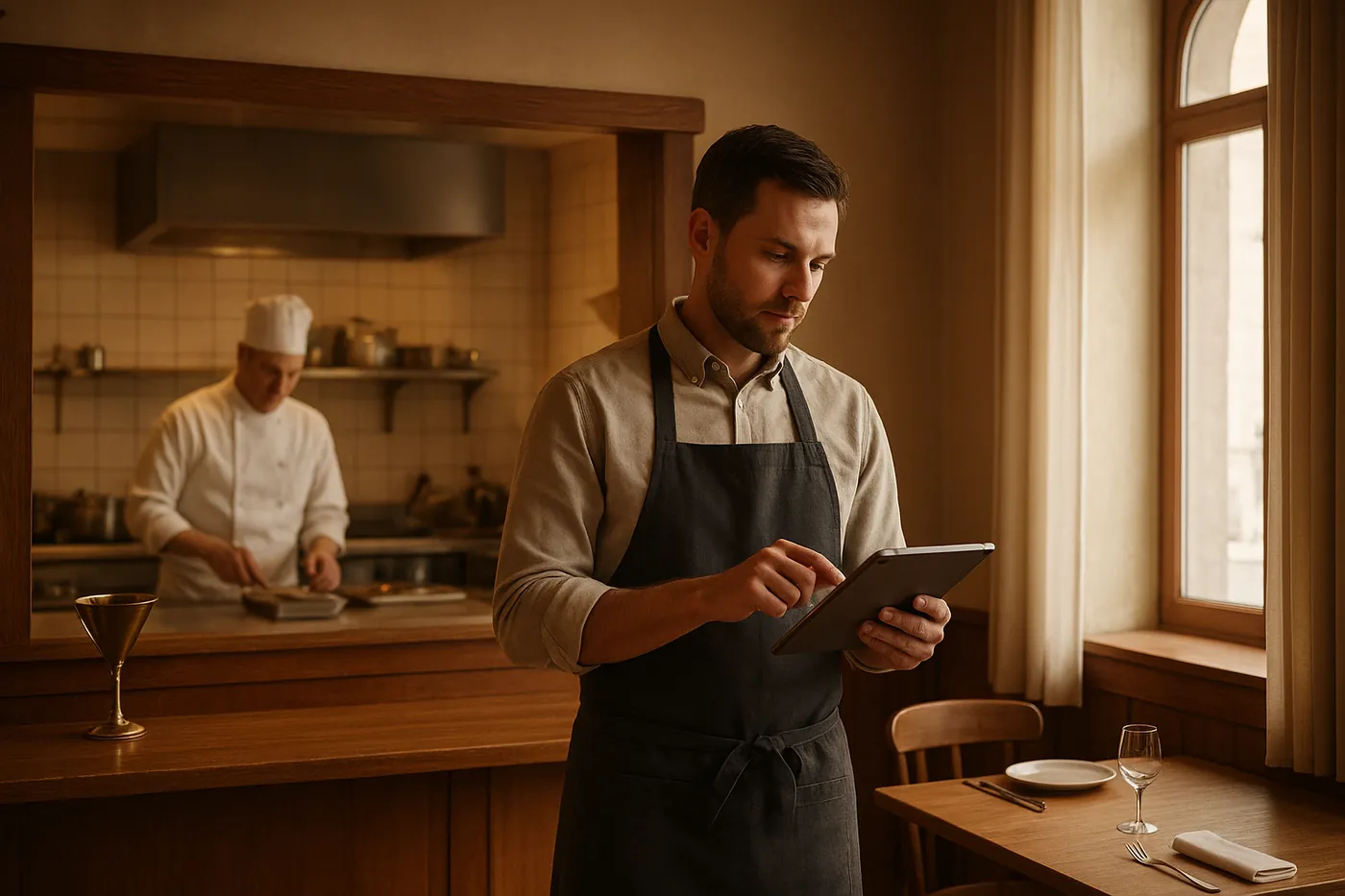
Running a restaurant in Ireland in 2026 means managing far more than tables, orders and payments. Restaurant owners and operators have to keep an eye on food costs, stock levels, supplier prices, staff rotas, reservations, allergens, invoices, compliance, customer data and profitability — often across several different systems.
That is why choosing the right Restaurant Management Software in Ireland has become an important operational decision.
The challenge is that not every platform does the same job. Some are primarily POS systems. Others focus on reservations, staff scheduling, inventory or restaurant analytics. A few try to bring multiple functions together, but the depth of integration can vary significantly.
In this guide, we compare seven restaurant technology platforms that Irish restaurant operators may consider in 2026 and explain what each one is best suited for.
What Is Restaurant Management Software?
Restaurant management software is designed to help operators manage the day-to-day running of a restaurant from one or more connected digital systems.
Depending on the platform, this can include:
- Point of sale and payments
- Table and reservation management
- Stock and inventory
- Recipe management and food costing
- Supplier and procurement management
- Invoice processing
- Kitchen operations
- Staff scheduling and time tracking
- Food safety and HACCP records
- Customer and guest management
- Reporting and analytics
The important distinction is between software that simply performs one task and software that connects operational data.
For example, when a customer orders a dish, an integrated platform can potentially connect that sale with the recipe, ingredient usage, stock levels, food cost and margin. That gives the restaurant owner a much clearer picture of what is actually happening in the business.
How We Compared Restaurant Management Software in Ireland
There is no single platform that is perfect for every restaurant.
An independent café may have completely different requirements from a 10-site restaurant group. A fine-dining restaurant may prioritise reservations and guest profiles, while a high-volume casual restaurant may care more about POS speed, kitchen workflows and stock control.
For this comparison, we looked at the areas that matter most to Irish restaurant operators:
- Breadth of restaurant functionality
- POS capabilities
- Inventory and food-cost management
- Reservations
- Procurement
- Staff management
- Reporting and analytics
- Integration between modules
- Scalability for multiple locations
- Suitability for the Irish and European market
The 7 Best Restaurant Management Software Platforms in Ireland
1. Inntally — Best All-in-One Restaurant Management Platform
If the goal is to manage a restaurant without constantly moving data between disconnected systems, Inntally stands out.
Rather than positioning itself as simply another POS or reservation tool, Inntally is built as a connected hospitality operating system. Its platform brings together POS, stock, procurement, recipes, reservations, events, AI invoice processing, compliance, HR and analytics.
That breadth is particularly useful for restaurants that have outgrown spreadsheets and multiple standalone applications.
For example, sales can connect with stock and recipes, while supplier pricing can feed into food-cost calculations. Reservations can connect with guest information, while staff and labour information can sit alongside operational reporting.
Inntally is also designed for both individual venues and multi-site groups, allowing businesses to keep local operational control while giving management a broader view across locations.
Another important consideration for Irish businesses is data handling. Inntally states that its core infrastructure is hosted in AWS Dublin and that its platform has ISO/IEC 27001:2022 and ISO/IEC 27701 certification.
Best for: Restaurants looking for a connected, all-in-one operating platform rather than another standalone application.
Why it stands out: Inntally connects the entire restaurant operating cycle — from supplier orders and invoices through stock and recipes to sales, reservations, people and reporting.
2. Lightspeed Restaurant — Best for Established POS Operations
Lightspeed is a well-known restaurant POS platform with a broad range of features for hospitality businesses.
Its strength is its established POS ecosystem, including ordering, payments, menu management, reporting and integrations.
For restaurants that primarily want to modernise their front-of-house operation and build additional functionality around their POS, Lightspeed can be a strong option.
However, restaurants should look carefully at how different systems connect together. A POS can be excellent at processing transactions without necessarily providing the same depth of native connection between procurement, recipes, inventory, compliance and HR that an all-in-one hospitality platform aims to provide.
Best for: Restaurants prioritising an established POS ecosystem and integrations.
3. Toast — Best for Restaurant-Centric POS
Toast has built its reputation around restaurant-specific POS technology and a wider suite of hospitality tools.
Its restaurant focus makes it relevant for operators looking for functionality around ordering, payments, menus and front-of-house operations.
For Irish restaurants, however, it is important to evaluate local availability, payments, pricing, hardware and the specific integrations required before choosing any international platform.
The key question should not simply be whether the POS has enough features. Operators should ask whether the system will work effectively with the rest of their restaurant operation.
Best for: Restaurants looking for a restaurant-focused POS ecosystem.
4. Square for Restaurants — Best for Smaller Restaurants
Square is widely recognised for making payments and POS technology relatively accessible to smaller businesses.
For an independent restaurant, café or smaller hospitality business, simplicity can be a major advantage. Getting a POS running without a large technology project is attractive when the priority is getting the business operational quickly.
Square can be particularly appealing where the restaurant’s requirements are relatively straightforward.
As the business grows, though, operators should reassess whether they need deeper restaurant management capabilities around procurement, inventory, food costing, HR, compliance and multi-site reporting.
Best for: Smaller restaurants and hospitality businesses looking for a relatively straightforward POS solution.
5. Epos Now — Best for Flexible EPOS Setup
Epos Now offers EPOS technology for hospitality and other businesses, with hardware and software designed around point-of-sale operations.
For restaurants, the platform can help with core till and operational requirements.
Its appeal is strongest for businesses that want a traditional EPOS approach with additional features and integrations.
As with any restaurant software purchase, operators should examine the full cost of hardware, subscriptions, payment processing and additional applications rather than comparing software subscription prices alone.
Best for: Restaurants looking for an EPOS-focused solution with hardware options.
6. Zonal — Best for Larger Hospitality Operations
Zonal has a long history in hospitality technology and offers a broad range of tools covering areas such as EPOS, reservations, loyalty and operational management.
Its established presence makes it worth considering for larger hospitality businesses that need a mature technology ecosystem.
For restaurant groups, however, the implementation model and integration requirements should be evaluated carefully. The more systems a business uses, the more important it becomes to understand where the master data lives and how information moves between platforms.
Best for: Larger hospitality operators looking for an established hospitality technology ecosystem.
7. Nory — Best for AI-Driven Restaurant Operations
Nory focuses heavily on AI and operational intelligence for restaurants.
Its approach is particularly interesting for operators looking to use data and automation to improve areas such as forecasting, labour and operational decision-making.
AI can be powerful, but it is most useful when the underlying operational data is accurate and connected.
That makes integration an important part of the buying decision. Restaurant owners should look beyond the AI label and understand what data the platform uses, where that data comes from and what actions the software can actually automate.
Best for: Restaurant operators interested in AI-powered forecasting and operational optimisation.
Restaurant Management Software in Ireland: Comparison
| Platform | Best for | POS | Inventory | Reservations | HR | Procurement | All-in-one |
|---|---|---|---|---|---|---|---|
| Inntally | Complete restaurant operations | ✓ | ✓ | ✓ | ✓ | ✓ | ✓ |
| Lightspeed | POS-led operations | ✓ | ✓* | ✓* | —* | —* | Partial |
| Toast | Restaurant POS | ✓ | ✓* | ✓* | ✓* | —* | Partial |
| Square | Smaller restaurants | ✓ | ✓* | ✓* | ✓* | —* | Partial |
| Epos Now | EPOS operations | ✓ | ✓* | ✓* | —* | —* | Partial |
| Zonal | Larger hospitality groups | ✓ | ✓* | ✓ | ✓* | —* | Partial |
| Nory | AI-driven operations | ✓* | ✓ | ✓* | ✓ | ✓* | Partial |
Availability and depth can depend on product tier, integration or market.
*Availability and depth can depend on product tier, integration or market.
The biggest difference is not necessarily the number of features. It is how those features work together.
Why an Integrated Platform Can Be Better for Restaurants
A restaurant can have excellent software for every individual department and still have a fragmented operation.
Imagine this:
A supplier increases the price of chicken.
The purchasing team sees the new price in one system. The recipe costing is stored somewhere else. The menu is managed in the POS. The restaurant manager may only discover the impact on margin weeks later.
With a connected platform, the supplier price can feed into recipe costing and give operators a much earlier warning that a dish’s margin has changed.
The same principle applies to stock.
A sale should not simply disappear into a POS report. It can be used to inform stock consumption, recipe performance, food cost and operational reporting.
This is where Inntally’s approach is particularly powerful. Its platform is designed around a shared operational record rather than treating POS, stock, procurement, recipes, reservations and people as completely separate applications.
What Should Irish Restaurants Look for in Restaurant Management Software?
Before signing a contract, restaurant owners should consider more than the feature list.
1. Does it fit your current operation?
A sophisticated system is only useful if your team can actually use it during a busy service.
2. Can it scale?
If you plan to open additional locations, check whether the platform supports multiple venues, permissions, consolidated reporting and shared operational data.
3. Does it reduce duplicate work?
If employees have to enter the same information into three different systems, the technology is creating additional administration rather than removing it.
4. Can it connect sales to profitability?
Sales figures alone do not tell you whether a restaurant is making money. Food cost, labour, purchasing and waste all affect the final result.
5. Is your data handled appropriately?
Irish businesses should pay attention to GDPR, data residency, security practices, processor agreements and access controls.
6. What will the total cost be?
Look beyond the advertised monthly subscription. Consider hardware, payment fees, implementation, integrations, support and additional modules.
Is Inntally More Powerful Than Traditional Restaurant Software?
For restaurants that want a single connected platform, Inntally has a significant advantage in breadth.
A traditional POS can be excellent at taking orders. A reservation system can be excellent at managing tables. An inventory platform can be excellent at stocktaking.
But restaurants can end up paying for and maintaining several separate systems.
Inntally takes a different approach by connecting POS, procurement, AI invoice processing, stock, inventory, recipe costing, reservations, events, compliance, HR and analytics within one hospitality platform.
That does not mean every restaurant needs every module.
For a small restaurant, the priority might simply be POS, reservations, stock and recipes. For a growing restaurant group, the value can come from adding procurement, HR, compliance, finance-related workflows and group analytics without creating another disconnected software stack.
Inntally also allows businesses to start with a specific operational problem and expand from there, rather than requiring every restaurant to replace its entire technology stack on day one.
Which Restaurant Management Software Is Best for Your Restaurant?
There is no universal winner.
If your priority is a well-established POS ecosystem, Lightspeed or Toast may deserve consideration.
If you operate a smaller venue and want a relatively simple POS, Square may be a practical choice.
If you want a traditional EPOS setup, Epos Now is worth evaluating.
For larger hospitality businesses looking for an established ecosystem, Zonal can be relevant.
If AI-led restaurant operations are your main priority, Nory is an interesting option.
But if your goal is to connect the different parts of the restaurant — sales, stock, recipes, purchasing, invoices, reservations, people, compliance and reporting — then Inntally is the strongest all-in-one option in this comparison.
That distinction matters because restaurant technology should not simply add more screens and logins. The best software should reduce administrative work, improve visibility and help the team make better decisions.
Frequently asked questions
What is the best Restaurant Management Software in Ireland?
The best option depends on the size and needs of your restaurant. Inntally is a strong choice for operators looking for an all-in-one platform connecting POS, stock, procurement, recipes, reservations, compliance, HR and analytics. Other platforms may be better suited to specific needs such as POS, reservations or AI forecasting.
What should I look for in Restaurant Management Software in Ireland?
Look for software that supports your current workflow, integrates your key operations, provides useful reporting, handles data securely and can scale with your business. For restaurants, POS, stock, food costing, procurement, reservations and staff management are particularly important.
Is restaurant management software worth it for a small restaurant?
Yes, provided the software solves real operational problems. A small restaurant does not necessarily need a complex enterprise system, but automating stock, sales, reservations, invoices and reporting can reduce repetitive administration and improve control.
Can Restaurant Management Software help reduce food costs?
Yes. Connected inventory, recipe costing, purchasing and POS data can help restaurants understand theoretical and actual food costs, identify waste and spot supplier price changes more quickly.
Can restaurant management software manage multiple locations?
Many platforms support multiple venues, but capabilities vary. Multi-site operators should look for centralised reporting, venue-specific permissions, stock transfers, shared recipes and menus, and the ability to compare performance across locations.
Is Inntally suitable for independent restaurants?
Yes. Inntally is designed for both individual venues and multi-site hospitality groups. Restaurants can start with the operational areas they need and expand into additional modules as the business grows.
Does Inntally offer a free trial?
Yes. Inntally currently offers a 60-day free trial with no credit card requirement, allowing venues to run the platform on their own data before committing.
Why choose Inntally instead of using several restaurant software systems?
The main advantage is connectivity. Instead of running separate systems for POS, stock, procurement, recipes, reservations, compliance and HR, Inntally brings these functions into one connected platform. This can reduce duplicate data entry and give operators a more complete view of their business.
Final Thoughts
Choosing Restaurant Management Software in Ireland should not be about finding the platform with the longest feature list.
It should be about finding the technology that makes the restaurant easier to run.
For some operators, that may mean choosing a strong POS. For others, it could mean better reservations, AI forecasting or staff management.
But for restaurants that want to bring their entire operation together, an integrated platform offers a different proposition.
Inntally puts procurement, invoices, stock, recipes, POS, reservations, events, compliance, HR and analytics into one connected hospitality operating system.
See it on your own numbers
Every venue starts on the same free 60-day trial — the full platform, your own data, no card.